JUNEAU, ALASKA, Sept. 6. - After nearly thirty days full of adventure our
exploration party has returned from a journey to Lake Teslin, in the interior of Alaska, through a wild, rich, rugged and beautiful country, which few white men have ever seen. Our trail marks a route to a point whence it is easy traveling to the Klondike.
It was like making a tour of discovery through a new world. Final preparations were completed Monday, August 12, and an hour later, in a driving rain, we left Juneau and faced the mountains.
The object of the expedition was to investigate the feasibility of a railroad to Lake Teslin. This lake may be reached and navivated by steamboats from the
mighty Yukon by way of its outiet, the Hootalinqua River, making navigation entirely possible from St. Michael to the head of the lake.
The railroad projett is backed by Preston Lea, a capitalist, banker and head of the street railway system of Wilmington, Del., ex-Senator Willard Saulsbury of
Delaware, and capitalists of New York and Philadelphia whom they have associated with them in the enterprise. A preliminary survey was made two years ago by P. I. Packard, hence the railroad does not owe its inception to the new discoveries on the Klondike.
The expedition: comprised P. I. Packard, agent and promoter of the Yukon Mining, Trading and Transportation Company, which is another name for the railroad; William Abbott Pratt, who holds the chair of electrical and mining engineering in the Delaware State University, and their assistants, T. G. Janney of Baltimore, Md., and A. E. Johnson of Victoria, B.C.; William J. Dick, a civil engineer formerly of Portland, Or., who, in 1887, assisted Professor Davidson and party in establishing by triangulation the altitude of Mount St. Elias; J. S. Johnson, general manager of the Alaska and Yukon Gold
Exportation and Trading Company, with headquarters at 322 Pine street, San Fran- cisco; Virgil Moore of San Francisco, and your special correspondent.
The expedition was also to have been joined by F. W. Johnson of San Francisco, formeriy a construction engineer of the Southern Pacific Railroad Company,
but he was detained at the last moment, and the party had to proceed with one less Johnson. J. S. Johnson's object was to inspect the mineral resources of the country. Added to the party were a number of Indian packers, several of whom were also found to be named Johnson. Serious trouble was had in the wilderness with the Indians, but that story comes in at its proper place in the narrative.
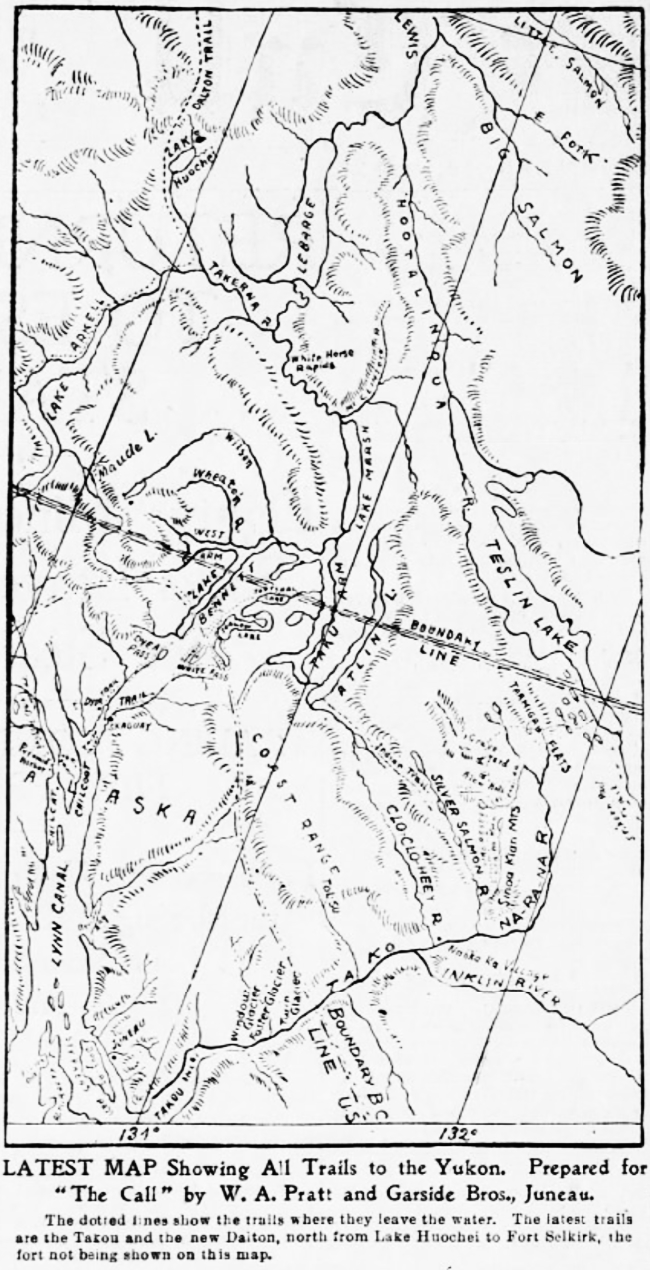
Leaving Juneau the party paddled south about ten miles to Takou Inlet. This inlet is about thirty miles long and from one to twenty miles in width, finally terminating in the Takou River. Our camp was made the first night at the mouth of the tunnel of the "Takou Queen" quartz ledge. This ledge was located about five weeks ago by William Gilber, Louis Steen, William Jones and Patrick Levy of Juneau. It is considered a very promising property. About midnight several of the party were aroused from slumber by the encroachment of the tide, and were compelled to take up their beds and walk to higher ground. As there was no room on which to pitch their beds a second time they had to wait till after the tide turned before they could take another snooze.
Several immense glaciers wall the sides of the inlet. They continuously break off and let down big icebergs into the water. When carried down by the swift current
of the river and swirling in the tide they make navigation of the inlet very hazardous. This scene is one never to be forgotten. Hundreds of icebergs of varying size and fantastic shape move in endless procession, some in a straight line, others in a circle, and stll others as though they were going through the figures of "forward and back" and "grand right and left" in a silent quadrille. One huge berg resembled a castle of the time of Louis IV as closely as anything could that's not a castle. It seemed painted in modern style and color. White ice at the base resembled a marble foundation, and it was sky blue
to its serrated battlements. The morning sun tipped the white minarets with gold. Others reminded the spectator of battleships and monitors. They had decks and turrets and towers of ice. At sundown, when the tide turned toward the open sea, the first iceberg sailed majestically by us. He was followed by countless others in chill parade,
But the most animated sight of all was in the early morning when the mighty Takou River struggled against his ancient antagonist, old ocean’s tide. In the center of the inlet the river seemed to have the better of the fight. Bergs and floes, hapless against the current, were swept on toward the ocean. But the incoming tide met them broadside on. Slowly old ocean triumphed, and the fickle forms turned back. Like a summer girl with two lovers, some were undecided and remained stationary, without choosing between tide or current. Others in the eddies, near the shore, hesitated, circled one way and then the other and finally turned back to the parent glacier. The whole spectacle was not unlike a stately minuet, with the booming of the avalanches of ice as they fell from
the fronts of the glaciers as its fitting music.
A strong breeze came with the changing tide, and with sails spread we were soon moving up the river. For twenty miles on each side steep and scantily wooded
mountains descend to the water. There is no spotin the entire distance fitted by nature for man’s habitation or even a camping-site. At 3 o’clock in the afternoon, as we began to get into thicker ice and nearer the glaciers, the old chief became more cautious and a litle anxious. The ice broke from the glaciers and fell into the river with an almost deafening noise. Annalatchi wanted to go into camp on a sandbar. Mr. Pratt would not
consent to this and the reluctant Indians sullenly continued on the course up the river.
All went well till we rounded a promontory of rock. There the current ran at least ten miles an hour. We had scarcely turned the point when we saw suddenly rushing down upon us nine great icebergs. There was ice to the left of us, ice to the right of us, ice all around us, and the point of rock behind. It was a critical moment - perhaps the most dangerous in the experience of every white man present.
The icebergs came nearer and nearer. To be struck by them meant death. Not an instant was to be lost. But mighty is the paddle of the Siwash. A guttural exclamation from Annalatchi and ihe paddies sank deep into the rushing flood. A few quick, swift strokes and the canoes shot through a narrow opening. The icebergs were behind us. We were safe for the present though still in the treacherous ice.
At this point we were passing the two glaciers, one of which is called "dead" and the other "alive," owing to their comparative activity. The dead glacier was brown in color and the live one blue. We could but dimly see the ice breaking off, but we could plainly hear the thunder of its fall. Waves were made to roll across the inlet when an unusually large section of the glacier spiashed into the water. These glaciers flow down to the water on either side of a great, round mountain. After passing them the way was free from the dangers of floating ice. As we proceeded the river gradually widened and
became more shallow.
* * *
So much for the trip; now for the practical results: From tidewater to Lake Teslin is 140 miles, of which eighty miles are by land. The Takou River runs over a
flat of rock, gravel and sand from one to two miles wide, traversed by the river in from four to twelve channels. Mr. Pratt, after a careful survey of the whole country, says a railroad can be buiit from Juneau to Lake Teslin without a single grade to exceed 3 per cent, unless from motives of economy it is found desirable to make a steeper grade and shorten the distance. He estimates the cost of construction of a broad-gauge road at about
$25,000 per mile, with the additional and considerable cost of transporting materials from the States added. There is wood euough on the ground for cross-ties, but it is not standing along the route.
Work on a road to be used next winter and spring by sleds may begin this fall. The plan of the projectors will in all probability be to construct the first half of the road from the head of navigation to the lake next season, and the remainder of the road a year from next season. The terminus of the first half would be at Silver Salmon River, and a wagon road would be made from that point on to the lake. As now surveyed the railroad will come out twenty-five miles below, instead of at the head of the lake. Extensive topographical notes were taken by Messrs. Packard and Pratt.
The confinement of the Takou River to one or two channels, so as to make nayvigation easier, will be among the first work to be done. It is ten miles south from
Juneau to Takou Inlet ana thirty miles up the inlet to the mouth of the river. Ocean steamers can run up to the mouth of the river.
The first river of any importance entering the Takou is the Tall-su-kay, which flows in on the west side, about thirty miles from the head of the inlet. Twenty
miles further on the Inklin River enters from the east. This point 1s called the "First Forks," and 1s really the head of the Takou. Here also the Nah-ka-na comes down from the mountains. Ten miles up the Nah-ka-na the Clo-co-hene River enters. The road may not be constructed from Juneau to the head of navigation until it is completed from that point to the lake.
The building of the road is said to depend only on the report of Pratt and Packard. Their report will be favorable. Mr. Pratt left Juneau to-day on the steamship City of Topeka, to be in Wilmington and Philadelphia as soon as possible and make his report.
Mr. Packard and the others of the surveying party will go to work after a few days’ rest surveying the road from Juneau to tne head of navigation. If he cannot get through to the Klondike this winter J. S. Johnson will remain camped at Lake Teslin. He said he had seen enough mineral on the trail to the lake to set a dozen companies to work.
If all present plans are carried out there will be three different lines of railroads toward Dawson City: One from Juneau up the Takou, another up the Skaguay Canyon and up over White Pass to Windy Arm and the third over the Stickeen trail, all terminating at navigable water. HAL HOFFMAN.