Most Canadians are familiar with the thrilling stories of the construction of the Canadian Pacific and Union Pacifie Railways, historic engineering achievements agatngst great odds that made the union of two great nations "more perfect."
Little is known generally, however, of the construction of the White Pass and Yukon Railway, a narrow gauge line, connecting Whitehorse in the Yukon with Skagway, Alaska. It is 110 miles long. But construction of this line was a most amazing engineering accomplishment. Started during the great Klondyke gold rush of '98, the rail line has played a great role in the grand strategy of the Second World War in the North Pacific area.
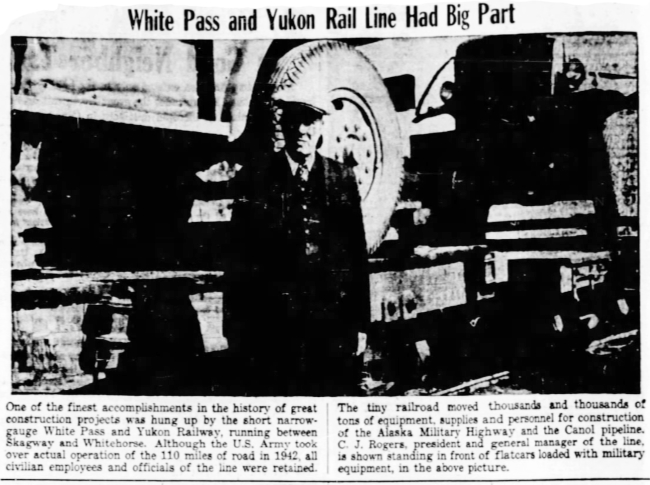
Much of the material and equipment used in the construction of the Alaska Highway, the military airports and the Canol oil line, were freighted over the famed White Pass and Yukon under the most severe weather conditions in four decades. - EDITOR.
By C. J. ROGERS
President and General Manager White Pass and Yukon Railway
When in 1897 there "broke" the story of the "Ton of Gold" that landed in Seattle on the old Steamer Portland, the main question from a great many citizens of the United States and Canada was "How do we get there?" Naturally there were many who wanted to answer that question to their own profit as a great movement of people great distances was in the offing. Many routes were tried and it is interesting to remember a few of them.
Taking the most easterly and working west, many stampeders went down the Mackenzie, starting from Edmonton and crossing over to the Yukon valley via the Porcupine River and then back up the Yukon to the Klondyke. This was a long strenuous trip and was taken in the summer on the rivers and in winter over the snow and ice.
There was a route from Fort George via Hazelton, Telegraph Creek and to the Yukon valley via the Teslin or Hootalingua River. This was called the "All Canadian
Route" and followed for a distance the route of the ill-fated Western Union telegraph line, which was intended to link America and Europe through Russia.
A third route was from Wrangell on the Alaska coast up the Stikine River to Telegraph Creek and then to the Yukon via Teslin.
A fourth route was from Wrangell om the Alaska coast to the end of Lynn Canal at Dyea, by trail, in winter or summer, over Chilcoot Pass, including a climb of about 1,000 feet practically straight up, reaching Lake Lindeman which empties into Lake Bennett through the disasterously crooked and swift short connecting river, which was the "last mile" for many.
A fifth route left the Alaska coast at Haines, up the Chilkat River, over the divide through what came to be known at the Dalton Trail, and on down the Yukon valley, reaching the Yukon at Carmacks. This was a low-level route and sufficiently swampy to provide feed for cattle and many destined for the Kiondyke market were driven over this trail by Jack Dalton and others.
Attempts were made to strike through from Cordova and Valdez, following somewhat the route travelled by Lieut. Schwatka of the U.S. Army many years before.
And then there was the all-water route via the open Pacific and Bering Sea to Fort St. Michael near the mouth of the Yukon River, and the long drag up the Yukon for some 1800 miles to the Kiondyke.
Many were the railway and other transport schemes hatched on paper, some of it gold embossed and costing cupidious people hard-earned money, but out of this welter of schemes, a stocky, determined little Irishman named Sam Graves saw the possibilities of a railway running from tidewater at Skagway to the headwaters of river navigation on the Yukon just below Miles Canyon and Whitehorse Rapids. Putting his faith in another not-so-small Irishman, Michael J. Heney, they started what looked from map mileage to be a comparatively simple job. But they soon found that they were in a tough country 1,000 miles from the limited market of the then small cities of Seattle, Vancouver and Victoria, and another 3,000 miles from the places where rails, spikes, tools, drill steel, locomotives, cars, and all the other things they needed were made.
SHORT OF MONEY
Three times they ran out of money and had to go back into the market and 'pay through the nose for it'. Labor, contrary to today's conditions, was not hard to get - it was only hard to keep. Many of the Klondyke stampeders who had gone broke on the trall were glad to go to work, both to live and to get needed money to continue their
journey, but rumors of great new finds of gold at all points of the compass were rife and many a morning the foremen found empty cots in the bunk tents. The men and the company's tools were away chasing the "Gold Bug", and it was necessary to rehire a crew and replenish the picks and shovels.
Probably no great engineering feat, and this is a good sized one, presented as difficult a task as this one, and the first of those fell to the locating engineers. They had to make their way through a valley and mountain pass entirely unmapped and about which there was no local knowledge as it had been "tabooed" by the superstitious Indians for generations, no doubt due to the loss of members of the tribe in blizzards in the dim past. Their name for the pass meant "North Wind", not usually a term of endearment even in civilized lands. Even in this present scientifically enlightened era and with the
birdseye view from the airplane, none but very minor corrections can be made in their "location".
STARTED IN WINTER
To be of amy great use to the stampeders or to its owners in financial returns the railway had to be completed speedily. Placer booms have a habit of going "phutt" overnight and the extent of the gold bearing gravels in the Klondyke were not then known. The last snarl of red tape, and there was plenty, dealing with three governments: the United States, British Columbia, and the Dominion government at Ottawa, who did not even know where their respective boundaries lay, was not finally untangled until August, 1898. Less intrepid adventurers would have waited till spring, as August is much closer to a "White Christmas" in these latitudes than it is further south. The record, however, is that the 20 miles of railroad from Skagway, which for 16 miles rises on a 4 per cent grade (nearly 208 feet each mile) to an elevation of just under 3,000 feet at the summit, and is entirely laid along a shelf cut in the granite of the mountains, was completed with the rails in place on January 20.
For another 20 miles the road was pushed along rock benches strewn with house-sized granite boulders brought there and left by the great glacial ice movement that carved the rugged mountain peaks and gouged out the valleys in this area; across ravines, through the hated but respected muskegs, skirting shallow mountain lakes, and always at that time of year in deep drifting snow, low temperatures, and blizzards. The rails were
laid into Bennett on June 20, 1897. To sum it up, during the winter of 1898-99, forty miles of railway, located at a spot two-thirds of the way to the North Pole from the
Equator, had been constructed, crossing the rugged coastal range in a pass 3,000 feet in elevation.
NO GAS ENGINES
This feat stands out in sharper relief when we remember that the gasoline internal combustion engine was almost a laboratory curiosity. There was no such thing as
a portable compressor or water pump. If a gasoline driven "Casey Jones" had suddenly overtaken a track gang they would have taken to the bush faster than a moose will today when a snorting locomotive invades his privacy. It would be some 17 years before the erroneously called (we know now) Great War would develop the germ of the present "cat", and longer than that before some one put a blade in front of it to make a bulldozer and then built the "Rube Goldberg" contraption we know as a carryall, tumble bug or turnapull,
The "machinery" used on building of the road consisted of hand picks and shovels, wheelbarrows, hay burners and scrapers, hand drills and hammers, and not until the road was practically completed did they even have an old time steam-driven shovel.
The men who made the stampede to the Klondyke were by natural selection the finest of physical specimens and so were the men who built the White Pass and Yukon Route.
Little did they dream that 44 years later a great horde of just as effectively, though artificially, selected men, mostly young, would land at that same Skagway beach by the hundreds and thousands, with great machines and with supplies, pipe, cement and many other things, and go roaring over the railway they of 40 years ago had built, to start in the centre and work east and west to meet at some point in the wilderness similar groups of young men who started from each end of the Alaskan Highway. Again speed was "of the essence", this time not for gain but to help assure that this country would not be over-run and taken by an enslaving enemy. How great a part in the decision of the enemy not to attempt to force his way east to the American continent may have been due to the speed and effectiveness of the effort of the American Army in these projects to deter an invasion, history may eventually disclose.
In any event, the many miles of highway, pipe and telegraph lines, and the refinery, all completed in the short space of exactly two years, are a tribute to the organizing and engineering skill of the U.S. Army and the youth, brains, and brawn of young America enlisted in that Army or recruited into the contractors' forces. Climatic conditions are no different in this country than they were in the "Days of '98" and much of the work was done in the winters of 42-43 and 43-44, and in many ways the necessity of speed made it necessary to live sometimes under conditions no better than those lived
under by the stampeders and the builders of the railway.
While we are paying tribute we should include on the Canadian
side the Royal Canadian Air Force, the Department of Transport and their constractors and men, and the United States Army Air Force and its contractors and men, for the speedy building and maintenance under the toughest conditions of the airfields which were of the most vital importance in the defensive and offensive operations.
Representing the owners and the employees of one of the links in this colossal chain of common effort, may I be pardoned if I point with pride, mixed with a proper proportion of humbleness, to the fact that for this transportation system, its railway handled in the two years under the auspices of the Army many times its gold rush
peaks in both freight and passengers, and its steamer lines contributed substantially to the distribution that made construction and completion on time possible.
Reverting to the first paragraph of this article dealing with the routes into the Yukon, we now can add two more completed and practical routes: A first-class, modern air route with the latest in directional and weather forecasting appliances, and a first-class military highway. What place these new routes will take in the days after
the war can only be conjectured now, but we in the White Pass and Yukon Route welcome them into the development of this country and are happy that we were able to contribute our share in their successful completion, and, we like to think, in the ultimate defeat of
the enemy.